
SCENARIO #6
Rosary Overreaction
As you are returning to your office, you pass a group of correctional officers. One of the officers asks to speak with you. He tells you that he had confiscated a plastic rosary from a client. The cord was seen as a security risk, as it could have been used to choke someone. The client claimed that the rosary was not his, but had been given to him by another client who is no longer in the institution. That client told the first client that he had been given the rosary by a Roman Catholic deacon. The correctional officer does not know who the second client had been, or the name of the alleged deacon. You thank the officer and tell him that you will look into this.
Citing specific guidelines, describe what you would do in this situation and why.
Immediately assuming guilt, I went right back to my office and sent out a rather terse and accusatory e-mail to all the Roman Catholic deacons who minister in that area. Every deacon promptly responded and assured me that they had never given out a rosary. I was no further ahead with my investigation and had perhaps damaged my relations with these volunteers.
GUIDELINE #1: THIS IS GOD’S WORK
- 1.1 (Excellence in what you CAN do) - I was not thorough in my handling of this incident. I had not gone to the area first and spoken with the client involved, in order to get the facts myself. I am reminded of Proverbs 18:13, “To give an answer before hearing is a foolish thing and a cause of shame.” I did not take a picture of the rosary and include it in my e-mail. I also did not follow-up with the officer and tell him the results of my investigation.
- 1.10 (Appreciate and nurture the network that God is giving you) - I did not show respect for, and give the benefit of the doubt to, my volunteers. I had been embarrassed to be stopped in the hall in front of correctional officers and kitchen staff. I reacted too quickly and did not think through the tone of my e-mail. It should have been more like, “Houston, we have a problem” and asked for their help in finding out what happened. By the accusatory tone, I was guilty of not watching my attitude (Guideline 1.12).
GUIDELINE #2: KNOW YOUR INSTITUTION
- 2.4.1 (Know the Policies and Procedures: e.g., health and safety first) - Rosaries were not given to clients for many years, because they had cords which can be used to choke someone. Recently, certain Catholic rosaries and Muslim prayer beads have been allowed into institutions.
FOLLOW-UP
I have seen progress / improvement in my response to similar situations since this incident. One example was where a mysterious pocket phone book showed up on a range and a correctional officer contacted me. I went and spoke with the officer and the client on whom the phone book was found. I found out which volunteer group was allegedly responsible and was able to exchange the phone book for several red address books from Gospel Echoes. Here is what the phone book looked like:
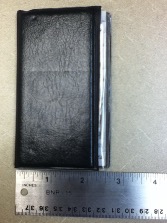
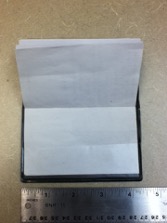
I sent these photos out in a general e-mail to all Chaplaincy volunteer groups that minister in that area of the institution, asking if anyone remembers giving this out. Predictably no one had, so the matter was dropped. I still do not know where the book had come from, but this time I had been more thorough AND had not jumped to conclusions and assumed guilt.